Suppose you pick three points at random in a disk in the Euclidean plane, and draw the unique circle that contains all three. The points are picked uniformly at random, which means that the probability that each of them lies in any given region is proportional to the area of that region, and independently, which means the probability for each point being in some region is completely unaffected by the positions of the other points. It’s possible that all three points will lie on a straight line, or that two or three of them will be identical, but all of these things happen with a probability of zero.
The average radius of the circle obtained this way turns out to be infinite, in the sense that the probability distribution for the radius does not have a finite mean value. However, the average curvature, κ, which is the reciprocal of the radius, has a finite value:
Average curvature of the circle
through three random points in a
Euclidean disk of radius ρ
κEuc(ρ) = 16 (3 – 16/π2) / (15 ρ) ≈ 1.47079 / ρ
In the following sections we will derive this formula, and some related results for points on a sphere.
Our goal in this section is to find the average curvature of the circle that contains three points chosen at random from a disk of radius ρ in the Euclidean plane.
Given the coordinates of the three points, it is not hard to write down a formula for the radius R of the circle that contains them. As a geometric starting point, R is equal to the product of the three side lengths of the triangle with the chosen points as its vertices, divided by four times the area of that triangle. Then the curvature, κ, is just the reciprocal, 1/R.
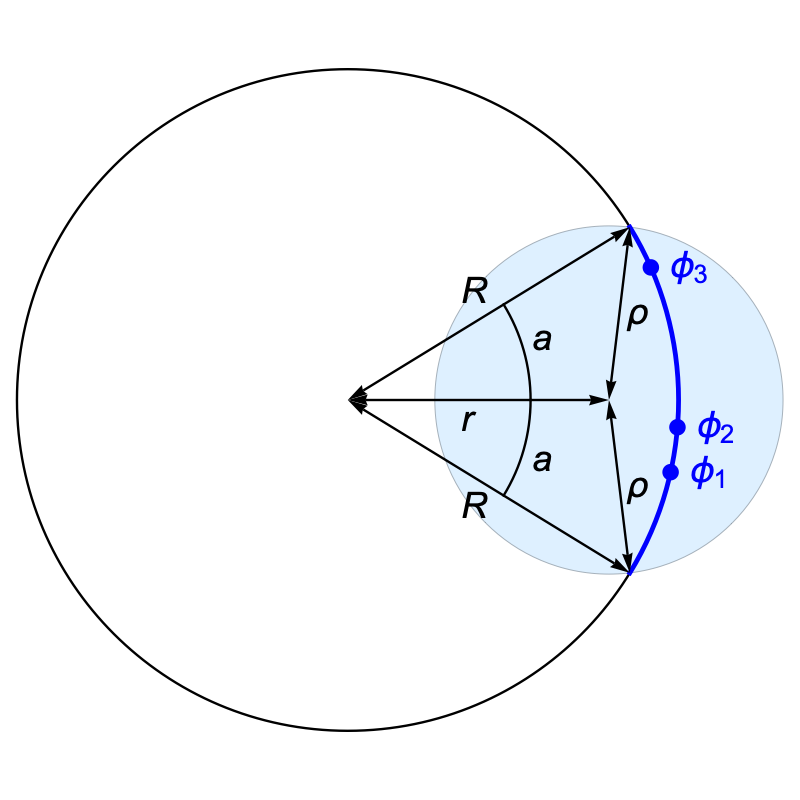
However, integrating κ over the six coordinate variables for the three points lying in the disk is very unwieldy, whether we use Cartesian or polar coordinates. An easier method is to use a set of variables in which the radius of the circle in question, R, is itself one of the variables. A convenient choice for the other five variables is then:
In the figure on the right, the disk of radius ρ is shown in light blue, while the circle of radius R is shown in black. All six variables are marked here, except for θ, which determines the angular position of the centre of the circle around the disk, and has no effect on the quantities we want to measure.
To find the average value of κ = 1/R, we need to integrate it over the region(s) in our new coordinate system that correspond to configurations where all three points lie inside the disk. Since we are choosing the points uniformly with respect to areas in the Euclidean plane, we need to weight our integral in the new coordinates with the absolute value of the Jacobian determinant (also known as the “change of variables factor”) which corresponds to the product of the three infinitesimal areas swept out in the plane as we make small changes to the six new variables.
The Cartesian coordinates of the three points in terms of the new variables are:
xi = r cos θ + R cos φi
yi = r sin θ + R sin φi
The determinant of the 6×6 matrix of partial derivatives of the six Cartesian coordinates with respect to the six new coordinates is:
JEuc = R3 r (sin(φ1 – φ2) + sin(φ2 – φ3) + sin(φ3 – φ1))
Suppose the three points are known to lie on an arc of the circle of radius R such that:
–a ≤ φi ≤ a
JEuc will change sign if we swap any two of the φi coordinates, so we can integrate the absolute value of JEuc over these coordinates by integrating over a region where the coordinates are ordered in a way that makes JEuc positive, then multiplying by six, the number of ways of permuting the three coordinates.
IEuc(R, r, a) = ∫–a ≤ φi ≤ a |JEuc| dφ1 dφ2 dφ3
= 6 ∫–a ≤ φ2 ≤ φ1 ≤ φ3 ≤ a JEuc dφ1 dφ2 dφ3
= 6 ∫–a a ∫φ2 a ∫φ1 a JEuc dφ3 dφ1 dφ2
= 6 R3 r ∫–a a ∫φ2 a (sin(φ1 – φ2)(a – φ1) + cos(φ2 – a) – cos(φ2 – φ1) – cos(a – φ1) + 1) dφ1 dφ2
= 6 R3 r ∫–a a (2 a – 2 φ2 – 3 sin(a – φ2) + (a – φ2) cos(a – φ2)) dφ2
= 24 R3 r A(a)
where A(a) = a2 + a sin(a) cos(a) – 2 sin(a)2
When the circle intersects the boundary of the disk, as in the figure above, the value of a can be found by the cosine law of triangles:
cos(a) = (R2 + r2 – ρ2) / (2 R r)
When 0 ≤ r ≤ ρ – R, the circle is entirely inside the disk, and we have a = π.
Region 1
Circle smaller than disk,
entirely inside it
R < ρ
0 ≤ r ≤ ρ – R
a = π
IEuc(R, r, π) = 24 π2 R3 r
In that case we must have R < ρ for the range of r values not to be empty, but there will also be cases where R < ρ and an incomplete (but nonempty) arc of the circle lies inside the disk:
Region 2
Circle smaller than disk,
partially inside it
R < ρ
ρ – R ≤ r ≤ ρ + R
0 ≤ a ≤ π
The upper bound here on r specifies that the circle is not so far away that it never reaches the disk, while the lower bound specifies that we don’t have the previous case, where the circle lies entirely inside the disk.
We also have a third possibility:
Region 3
Circle larger than disk,
partially inside it
R > ρ
R – ρ ≤ r ≤ ρ + R
0 ≤ a ≤ π/2
Here the upper bound on r serves the same purpose as before, while the lower bound specifies that the disk doesn’t lie entirely inside the circle.
For each of these three regions, we will integrate three things, weighted by the change of variables factor |JEuc|:
It’s straightforward to integrate over the first region, 0 ≤ R ≤ ρ and 0 ≤ r ≤ ρ – R. We multiply by an extra factor of 2π to integrate over the polar coordinate θ for the centre of the circle.
IEuc 1(1) = 2π ∫0ρ ∫0ρ – R 24 π2 R3 r dr dR
= (2/5) (π ρ2)3
IEuc 1(R) = 2π ∫0ρ ∫0ρ – R 24 π2 R4 r dr dR
= (8ρ/35) (π ρ2)3
IEuc 1(κ) = 2π ∫0ρ ∫0ρ – R 24 π2 R2 r dr dR
= (4/(5ρ)) (π ρ2)3
For the second region, where R < ρ and ρ – R ≤ r ≤ ρ + R, the angle a decreases monotonically from π when r = ρ – R down to zero when r = ρ + R. It will be simpler to change variables from r to a rather than substituting for a as a function of R and r.
We can rearrange the cosine law into a quadratic in r:
r2 – 2 R r cos(a) + (R2 – ρ2) = 0
which is solved by:
r = R cos(a) ± √[ρ2 – R2 sin(a)2]
To change the integration variable from r to a we need:
r dr/da = d(½r2)/da = dS±(R, a)/da
where S±(R, a) = ½(r2 – ρ2) = ½R2 (cos(a)2 – sin(a)2) ± R cos(a) √[ρ2 – R2 sin(a)2]
When R < ρ we take the + sign in the solution. Rather than compute the derivative of S(R, a) we will integrate by parts with respect to a, but first we will integrate with respect to R:
S1(a) = ∫0ρ R3 S+(R, a) dR = (ρ6 / 192) (16 cos(2a) + |cos(a)| (12 (a – πa > π/2) – 3 sin(2a) – 3 sin(4a) + sin(6a)) / sin(a)5)
SR(a) = ∫0ρ R4 S+(R, a) dR = (ρ7 / 210) (15 cos(2a) + 2 cos(a) (8 + |cos(a)| (15 sin(a)6 – 3 sin(a)4 – 4 sin(a)2 – 8)) / sin(a)6)
Sκ(a) = ∫0ρ R2 S+(R, a) dR = (ρ5 / 30) (3 cos(2a) + cos(a) (|cos(a)3| (3 cos(2a) – 7) + 4)) / sin(a)4)
Integrating by parts with respect to a gives us:
IEuc 2(1) = 48π ∫π0 A(a) S1'(a) da
= 48π (A(a) S1(a) |π0 – ∫π0 A'(a) S1(a) da)
= (2/5) (9 – 80/π2) (π ρ2)3
IEuc 2(R) = 48π ∫π0 A(a) SR'(a) da
= 48π (A(a) SR(a) |π0 – ∫π0 A'(a) SR(a) da)
= (ρ/525) (1485 + (16/π2) (64 log(2) – 877)) (π ρ2)3
IEuc 2(κ) = 48π ∫π0 A(a) Sκ'(a) da
= 48π (A(a) Sκ(a) |π0 – ∫π0 A'(a) Sκ(a) da)
= ((3/5) (9 – 80/π2)/ρ) (π ρ2)3
For the third region, R > ρ and R – ρ ≤ r ≤ ρ + R, the circle is larger than the disk, and a is zero at both endpoints of the range for r, with the circle and the disk intersecting at a single point, and the interior of the disk either wholly inside or wholly outside the circle.
In between those endpoints, a reaches a maximum value when:
r = rmax a = √[R2 – ρ2]
a = amax = acos(rmax a / R) = asin(ρ/R)
Each angle a between 0 and amax is now associated with two different values of r, which are the two roots of the quadratic we described earlier. We can combine the two versions of r dr/da for the two roots into a single integral over a, taking the difference rather than the sum to account for the fact that the endpoints for a are swapped for the different ranges for r, above and below rmax a. So the integrals for the third region are:
IEuc 3(Rn) = 96π ∫ρ∞ ∫0asin(ρ/R) A(a) sin(a) Rn+4 (ρ2 + R2 (cos(a)2 – sin(a)2)) / √[ρ2 – R2 sin(a)2] da dR
We will perform a change of variable:
R = ρ / sin(b)
dR/db = –ρ cos(b) / sin(b)2
amax = asin(ρ/R) = b
The limits of ρ and ∞ for the integral over R become b = π/2 and b = 0. So we have:
IEuc 3(Rn) = 96π ∫0π/2 ∫0b A(a) sin(a) (ρ / sin(b))n+4 (ρ2 + (ρ / sin(b))2 (cos(a)2 – sin(a)2)) / √[ρ2 – (ρ / sin(b))2 sin(a)2] (ρ cos(b) / sin(b)2) da db
= 96π ρn+6 ∫0π/2 ∫0b A(a) sin(a) (cos(b) / sin(b)n+7) (sin(b)2 + cos(a)2 – sin(a)2) / √[sin(b)2 – sin(a)2]) da db
[We swap the order of integration, still covering the same region: 0 < a < b < π/2]
= 96π ρn+6 ∫0π/2 ∫aπ/2 A(a) sin(a) (cos(b) / sin(b)n+7) (sin(b)2 + cos(a)2 – sin(a)2) / √[sin(b)2 – sin(a)2]) db da
For n = 0, 1, –1:
IEuc 3(1) = 96π ρ6 ∫0π/2 ∫aπ/2 A(a) sin(a) (cos(b) / sin(b)7) (sin(b)2 + cos(a)2 – sin(a)2) / √[sin(b)2 – sin(a)2]) db da
[Substitute u = sin(b)2, du = 2 sin(b) cos(b) db]
= 48π ρ6 ∫0π/2 ∫sin(a)21 A(a) sin(a) (1 / u4) (u + cos(a)2 – sin(a)2) / √[u – sin(a)2]) du da
= 2 π ρ6 ∫0π/2 A(a) (1 / sin(a)6) (3 (4 cos(a)2 + 1) (π/2 – a) + sin(a) cos(a) (15 – 2 (sin(a)2 + 8 sin(a)6))) da
= (32/π2 – 3) (π ρ2)3
IEuc 3(R) = 96π ρ7 ∫0π/2 ∫aπ/2 A(a) sin(a) (cos(b) / sin(b)8) (sin(b)2 + cos(a)2 – sin(a)2) / √[sin(b)2 – sin(a)2]) db da
= (2π/35) ρ7 ∫0π/2 A(a) cos(a)3 (768 + 512 sin(a)2 + 480 sin(a)4 + 480 sin(a)6) / sin(a)7 da
For values of a near zero the integrand here is proportional to 1/a, so the integral diverges.
IEuc 3(κ) = 96π ρ5 ∫0π/2 ∫aπ/2 A(a) sin(a) (cos(b) / sin(b)6) (sin(b)2 + cos(a)2 – sin(a)2) / √[sin(b)2 – sin(a)2]) db da
= (64π/5) ρ5 ∫0π/2 A(a) (4 – sin(a)2 – 3 sin(a)6) cos(a) / sin(a)5 da
= ((464/(15π2) – 3)/ρ) (π ρ2)3
We can now check that the overall 6-volume is correct:
IEuc 1(1) + IEuc 2(1) + IEuc 3(1)
= (2/5 + (2/5) (9 – 80/π2) + (32/π2 – 3)) (π ρ2)3
= (π ρ2)3
This is exactly what it should be: the cube of the area of the disk, with one factor for each of the three points that lie within it.
And we can now compute the average curvature of the circle that passes through three random points within the disk:
Average curvature of the circle
through three random points in a
Euclidean disk of radius ρ
κEuc(ρ) = (IEuc 1(κ) + IEuc 2(κ) + IEuc 3(κ)) / (π ρ2)3
= (4/5 + 27/5 – 48/π2 + 464/(15π2) – 3) / ρ
= 16 (3 – 16/π2) / (15 ρ)
≈ 1.47079 / ρ
The curvature of the circle that passes through three points in a Euclidean space is sometimes known as the Menger curvature. In the context of spherical and hyperbolic geometry, the usage is a bit less clear. In that setting, we will be calculating the geodesic curvature, which measures how much the curve departs from being a geodesic, which is not the same as the Menger curvature as it is usually defined for a general metric space.
Although the average radius of the circle that passes through three random points in a Euclidean disk is not defined, the integrals we have computed allow us to find the average radius in a restricted version of the same scenario. Suppose we pick three points in the disk at random, calculate the radius of the circle, and then reject that sample if the radius of the circle is greater than the radius of the disk. We can quantify the probability of choosing three points where the radius is less than that of the disk, and give the average of the radius under those restricted conditions.
Average radius of the circle
through three random points in a
Euclidean disk of radius ρ,
if we only accept samples where the circle’s
radius R < ρ
Prob(R < ρ) = (IEuc 1(1) + IEuc 2(1)) / (π ρ2)3
= (4 – 32/π2)
≈ 0.757722
Average {R | R < ρ} = (IEuc 1(R) + IEuc 2(R)) / (IEuc 1(1) + IEuc 2(1))
= (1605 π2 + 16 (64 log(2) – 877)) ρ / (2100 (π2 – 8))
≈ 0.641464 ρ
|
|
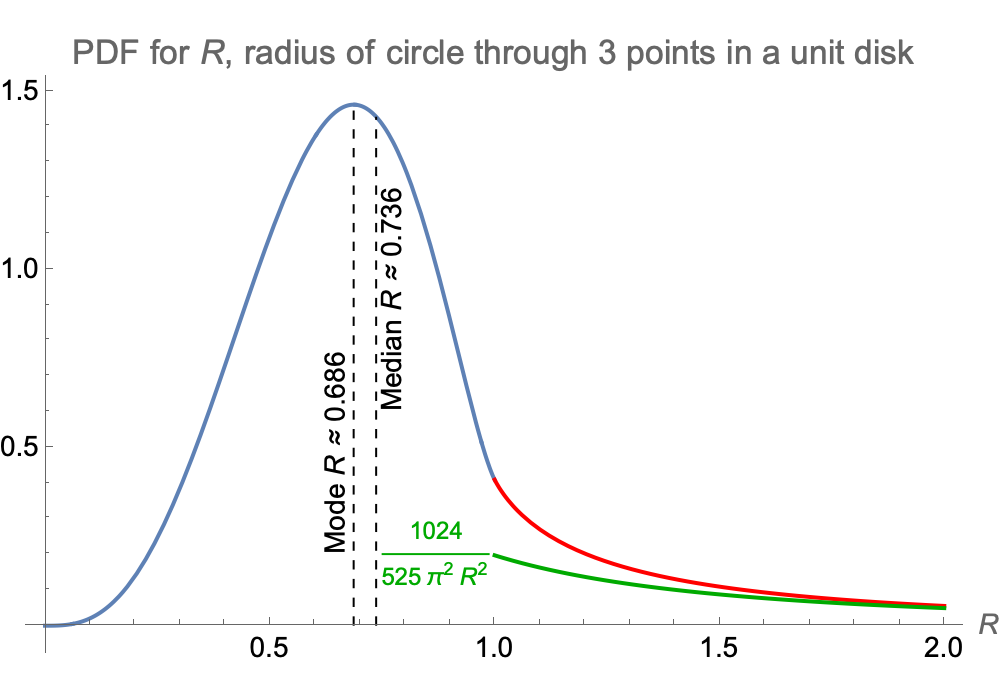
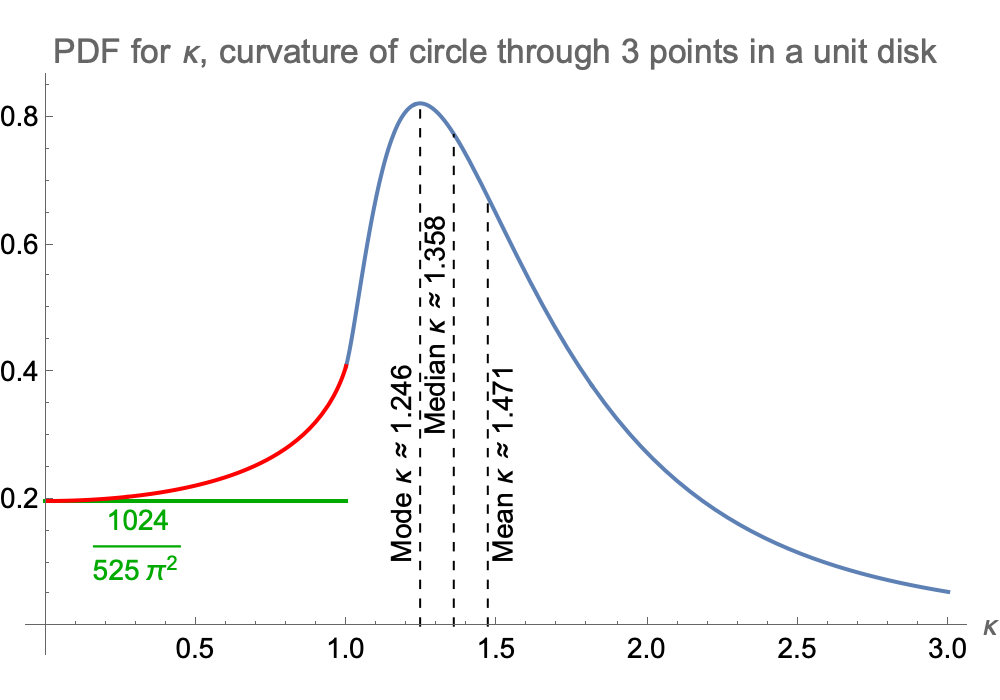
We can compute the probability density function (PDF) for R by omitting the integration over R in the computations for the three 6-volumes that we carried out earlier, then dividing by the total 6-volume. For regions 1 and 2 we can obtain a closed-form result as a function of R/ρ, but for region 3 the integral over a for each value of R needs to be performed numerically.
The figures on the right show the PDFs for the radius R and the curvature κ. We have set ρ=1, so we are choosing the three points from a unit disk, but for other values of ρ the curves are just rescaled horizontally, and in fact they will look exactly like these figures if we choose to plot R/ρ and κ ρ along the horizontal axes.
The red portions of the curves correspond to region 3, where R > ρ. The green curves give the asymptotic behaviour for large values of R. That the PDF for R is asymptotic to a constant times 1/R2 makes it clear that R cannot have a finite mean, since the integral of 1/R from any point out to infinity does not converge.
The PDF for R < ρ, with contributions from region 1 and 2, is:
PDFR(R, ρ) = (6 μ/π2)
[μ (μ (π2 (μ2+4)–15μ)–9) + 5 (3μ4–4μ2+1) atan(μ) + (4–24μ2) Li2(μ) + (6μ2–1) Li2(μ2)]
where μ = R/ρ
and Li2 is the polylogarithm function of order 2
The PDF for the curvature κ > 1/ρ is then:
PDFκ(κ, ρ)
= PDFR(1/κ, ρ) | dR/dκ |
= PDFR(1/κ, ρ) / κ2
For region 3, the contribution to the 6-volume is:
IEuc 3(1) = 96π ∫ρ∞ ∫0asin(ρ/R) A(a) sin(a) R4 (ρ2 + R2 (cos(a)2 – sin(a)2)) /
√[ρ2 – R2 sin(a)2] da dR
If we drop the integration over R, divide by the total 6-volume (π ρ2)3, set R = 1/κ and change variables from a to α = a/(ρ κ), then to the lowest order in κ:
PDFR(R, ρ) ≈ (64 ρ / (15 π2)) κ2 ∫01 α7 / √[1 – α2] dα
= (64 ρ / (15 π2)) κ2 (16/35)
= 1024 ρ / (525 π2 R2)
This gives us the green curves that show the asymptotic behaviour for large values of R, or equivalently, low values of κ.
On a sphere, every circle has two centres. For example, every circle of latitude on the Earth has a centre at both the north and south poles: both points are equidistant from every point on the circle. By the radius of a circle on the sphere, we will mean the angle between the points of the circle and the nearest of the two centres, which can never exceed π/2.
The radius R in this context can be thought of either as an angle, or as the distance from the circle’s centre, on a unit sphere, as measured along the surface. It is not the radius of the same circle when considered as a circle in three-dimensional Euclidean space, where the centre will lie in the same plane as the circle, rather than on the surface of the sphere.
The geodesic curvature of a circle with radius R on a unit sphere is not the reciprocal of the radius, but the reciprocal of tan(R):
κg = 1/tan(R) = cot(R)
Using this definition, any great circle, which has R = π/2, has zero geodesic curvature, which is what we would expect.
There are two easy calculations we can make for the case where we pick three points from the entire surface of the sphere. Because the situation is so symmetrical and there are no constraints on the location of the points, we can just weight each configuration by the probability of all three points lying in an infinitesimally thick annulus containing the circle in question. For each point this is proportional to sin(R), and so for three points it is proportional to sin(R)3.
Average radius and curvature of the circle
passing through three random points on a
unit sphere
RSphere = ∫0π/2 R sin(R)3 dR / ∫0π/2 sin(R)3 dR
= (7/9) / (2/3)
= 7/6
κSphere = ∫0π/2 cot(R) sin(R)3 dR / ∫0π/2 sin(R)3 dR
= (1/3) / (2/3)
= 1/2
 |
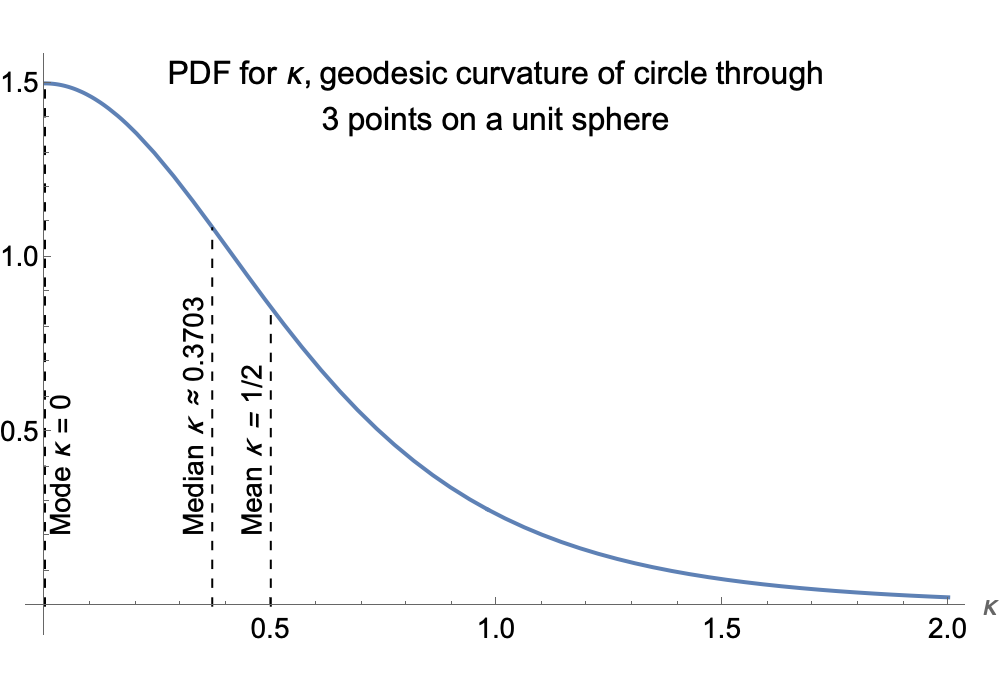 |
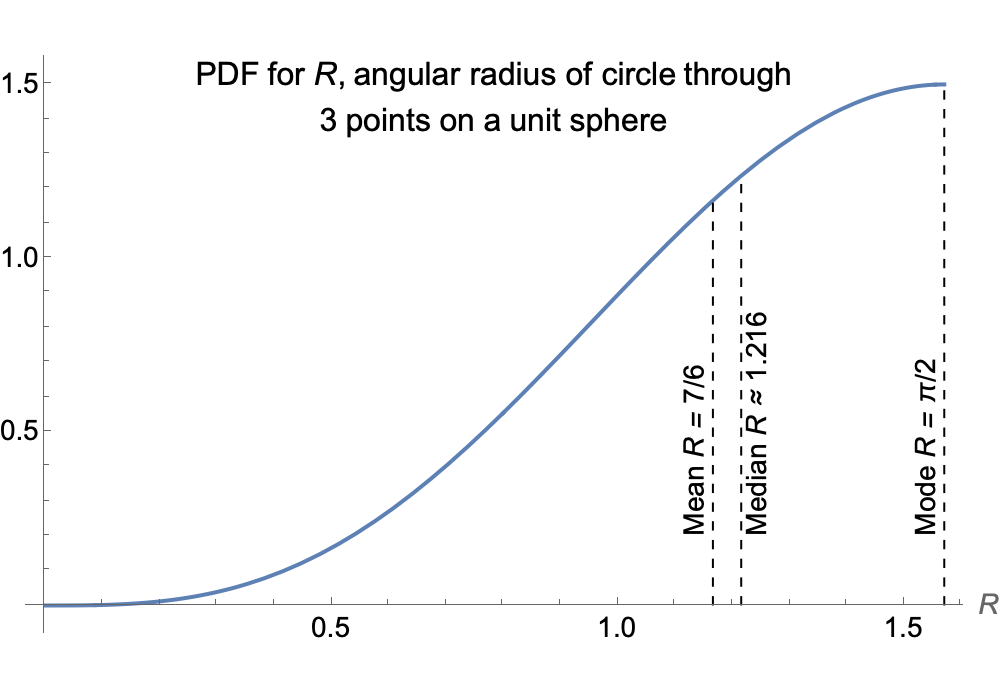
The first of these calculations is enough to tell us that, for the unit sphere, the probability density function for R is:
PDFR(R) = (3/2) sin(R)3
We can then derive the PDF for κ = cot(R):
PDFκ(κ)
= PDFR(acot(κ)) | d(acot(κ))/dκ |
= 3 / [2 (κ2 + 1)5/2]
The corresponding cumulative density functions are the integrals of the PDFs:
CDFR(R) = ∫0R (3/2) sin(R)3 dR
= ½ (cos(R)3 – 3 cos(R) + 2)
CDFκ(κ) = ∫0κ 3 / [2 (κ2 + 1)5/2] dκ
= κ (2κ2 + 3) / [2 (κ2 + 1)3/2]
These CDFs allow us to write the medians of the distributions, i.e. the values where the CDF equals ½, as simple functions of a root of a cubic polynomial:
Median R = acos(y) ≈ 1.21611
where y3 – 3y + 1 = 0 and |y| < 1
give y ≈ 0.347296
Median κ = cot(Median R)
= cot(acos(y))
= y / √[1 – y2]
≈ 0.370349